
OUR MISSION
The Rural Urban Bridge Initiative invites all of us to think differently, talk differently and act differently in order to understand the causes of the rural-urban divide and then do something to repair it. We develop political, economic and communications strategies that build bridges and serve the common interests of all working and middle class Americans.
-
Learn about the causes and consequences of the rural-urban divide.
Consider the diverse perspectives and priorities of rural working people.
Set aside stereotypical assumptions about people based on their zip code or formal education.
Understand the challenges and strengths of rural and small town communities adapting to decades of deindustrialization, population decline, and family farm losses.
Take stock of ways in which the two major parties have failed them.
Recognize that people who take pride in self-reliance sometimes feel shame or resentment when they must rely on government assistance.
Reflect on the ways in which the land and labors of rural people make modern life possible.
-
Learn to engage in respectful dialogue across lines of difference.
Share your values and opinions without dehumanizing or acting superior to those who were raised to see things differently.
Learn how to talk about racism and other forms of prejudice in ways that don’t trigger defensiveness.
Talk like a neighbor, not an activist. Don’t censor, lecture, scold or use slogans like “America is already great” that don’t ring true.
Don’t doomsay or exaggerate. Avoid language that is academic, wordy, dogmatic, condescending, self-righteous, or trendy.
Let people know that your goal is not to convince them but to understand their needs and seek common ground.
-
Make the concerns of rural poor and working people as high a priority as other progressive concerns.
Consider solutions that are universal as well as those that are uniquely responsive to rural needs.
Engage local knowledge, expertise and values instead of proposing top-down policies designed by distant bureaucrats.
Invest in rural institutions that have already earned the public’s trust.
Bring rural voices into universities, media and the arts.
Reverse trade and agriculture policies that have left farmers and blue collar workers high and dry.
Confront industries that treat rural areas like resource colonies, and corporations who bust unions, raid pensions and shutter local hospitals, banks and newspapers.
Challenge political parties to put people and planet ahead of profits.
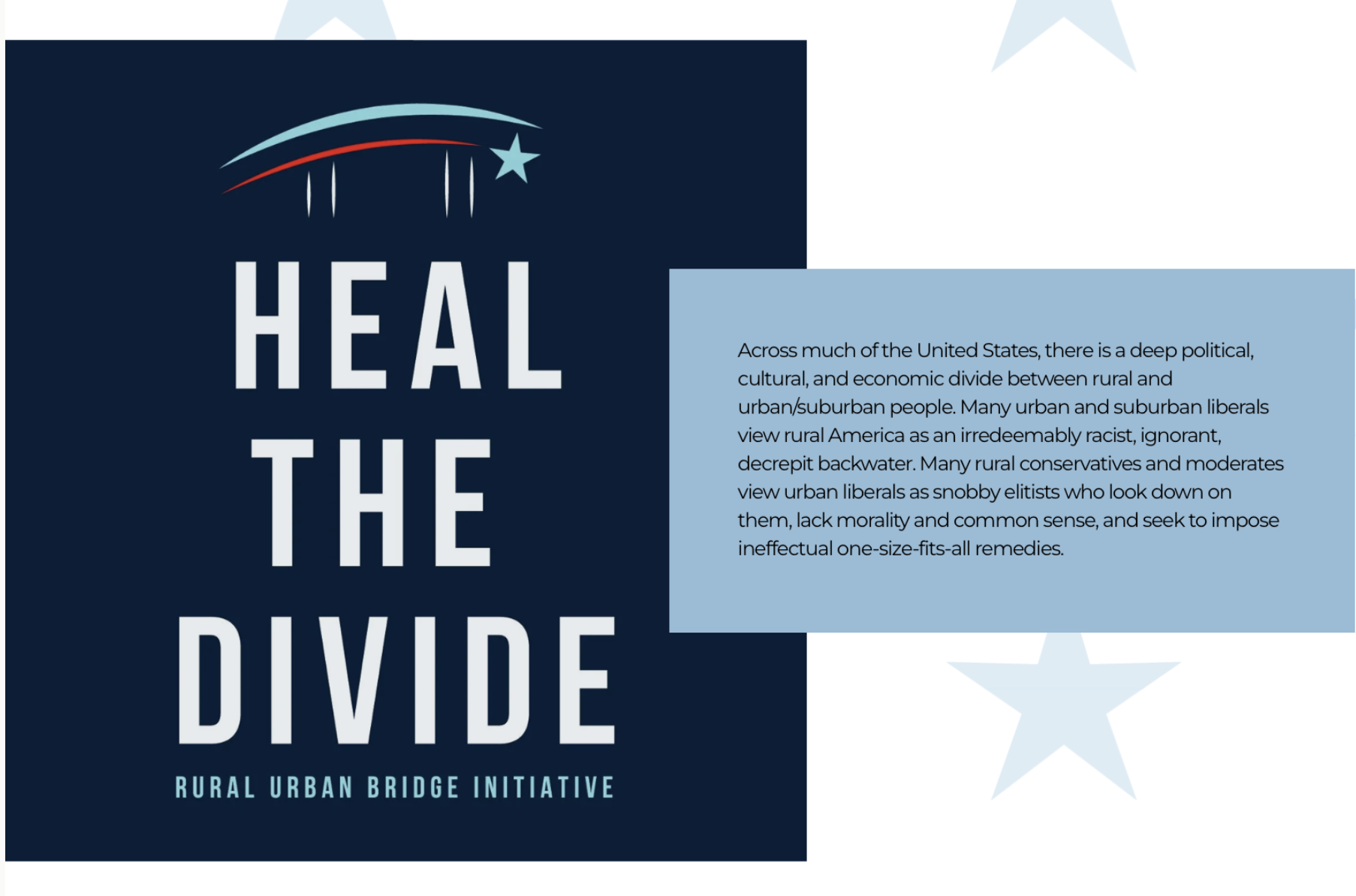
Why Bridging the Divide Is Crucial
The fates of rural, urban, and suburban America are intertwined. Rural communities provide the vast majority of the food, fiber, energy, and materials that modern life depends on — and what happens in one America never stays there. Rural crisis, urban impact: urban crisis, rural impact. Hollowed-out rural economies strain the systems cities rely on and warp national politics; struggling cities shrink the markets, institutions, and investment that small towns need to survive.
For decades, wealth has been extracted from rural communities with little lasting benefit for the people who live there. Many rural Americans feel taken for granted — and that resentment means progressive ideas, whether a public bank, a solar-powered school, or a unionization drive, are rejected before they get a fair hearing. Depolarization opens that space back up.
t's also a democracy problem. Most rural areas live under what amounts to one-party rule, leaving tens of millions of working Americans represented by politicians who do little to protect their jobs, schools, hospitals, or farms — while gerrymandering, the Electoral College, and the Senate carry the consequences to everyone.
The stakes are national. Rural voters make up more than 40% of the electorate in many battleground states, and a swing of just 2–3% can decide elections. And rural America has never been inherently red: it's the birthplace of the prairie populists, and progressive institutions like the Bank of North Dakota, farmers unions, and electric co-ops still anchor rural life today.
When politics is zero-sum — rural against urban, native-born against immigrant — people hunker down. But when people feel heard and know someone has their back, they're more open to universal programs that give everyone a hand up. That's the work of bridging the divide.